
Although I’ve often wondered about who and how people have created inventions, I only had two thoughts in answer to this prompt. One was to un-invent nuclear weapons, and the other was to un-invent racism. I don’t know enough about nuclear weapons, but racism has been much on my mind in recent years. If we were able to un-invent racism, I believe it would go a long way to bettering humanity as a whole.
Racism is a complex socioeconomic, sometimes religious, construct that has a long, awful history behind it. Endless excuses and justifications have been made for its perpetuation, and sadly deconstructing racism has had a one step forward, two steps back rate of progress lately.
As a human fabrication, how did racism originally come about? Does racism’s origins hold answers for how we could un-invent it in modern times? For the purposes of examining some of the mechanisms of racism, let’s imagine we are talking about one person, calmly and slowly approaching another. They aren’t holding anything, they are dressed similarly, and both person’s faces carry neutral expressions. No sounds or words are spoken, and they are several feet away from each other, so smells are not detectable either.
Biology as a base
I’ve heard statements about children not being inherently racist, that racism is something learned, not innate. There have been studies examining infant reactions to faces which show that babies are better at recognizing and differentiating faces of their own ethnicity than those of others. This is referred to as ORE, or Other Race Effect, a theory of facial processing that debates whether people see the composite features of a face or scan the overall shape. ORE theory is an attempt to explain implicit bias. If our brains are wired to quickly process visual information and make a snap judgement – same: safe/ different: dangerous, then the biological mechanism for this behavior makes sense, in a very broad way, for one person being wary of another who looks differently. It does not condone violence, judgement or any actions to harm the other person just based upon their features or skin tone being different.
I could see ORE being a useful, efficient method of assessing other beings in an environment when it comes to different species1, but as an argument for racism it is pathetically weak. Sure, if a tiger is running up at me and my primitive amygdala gauges the much larger, pointier teeth as a threat, that is a justifiable evaluation. But referring back to our imagined approach, one person calmly walking toward another, not saying anything, dressed the same, face neutral is simply a situation where more information is needed.
A ton of information is neurologically processed through visual stimuli. For that matter, our brains process information from all five senses, not solely one data set. As animals, humans look at other beings and decide, before any interaction has happened, what they expect from the other entity. Where does that judgement come from?
Philosophical Ponderings
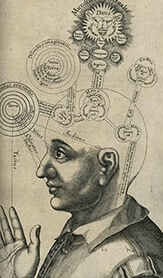
During the age of Enlightenment, (the 1500s,) physicians were basically polymaths. They didn’t only study medicine, they were astrologers, alchemists, mathematicians and often even had religious backgrounds. This diagram, by Robert Fludd, outlined his theory of cognition – that our mental action of acquiring knowledge occurs through our senses, experiences, thought and reception of sendings from the divine.
Our senses alone don’t give us enough information to discern what type of person is approaching or what their intentions may be. I’m not getting into the discussion of divine sendings, because that is a whole other bag of worms. A previous post touches upon how thoughts come about, which is a subject I find intensely interesting but is also too complex to delve into here. So we’re left with the last source of cognition- experiences.
Experience & Exposure
Life is a composite of positive and negative experiences. Those we have at younger ages tend to imprint upon us in a big way, but we are (theoretically) capable of learning our whole lives, one experience overwriting another, providing us with a new dataset by which to move forward. Some people may be “wired” to hold on to old information, but I am not one. I may have had interactions with people in my life that haven’t been enjoyable, but I would say I’m lucky in that I’ve never had exchanges with one race or another that are consistently good or bad, to the point where I feel it necessary or justifiable to stereotype an entire race.
In 2021, I read a NYTimes article that indicated two of the most useful ways we can teach our children to be anti-racist: 1) Talk with them about racism and 2) Encourage interactions with people of different races, specifically by encouraging our children toward friendship with different races, because “Friendships are a major mechanism for promoting acceptance and reducing prejudice.” If you live in an area where there is a dominant racial population, media can be a blessing here; seek out stories which show characters of different races on tv, via the internet and in books. We can’t shy away from discussing the endemic problem of racism. There isn’t a simple fix. But we can begin by calling out the discrepancies in people’s opportunities and treatment, and how our societies and governments are designed to benefit one race over others, we shed light on the problems, so that we can then discuss solutions.
Blame Your Amygdala
Going back to our imaginary encounter of one person simply, neutrally approaching another, for whatever reason I imagined this happening between early homo sapiens. What would one person do, when confronted with someone whose physiotype presented very differently from their own? Maybe yes, they would’ve been somewhat threatened; after all, resources were scarce, life was full of threats and everything was unknown. Small tribes of people may have shared ancestral knowledge about good watering holes, carnivorous animals or aggressive “others” to avoid. Physical descriptors may have been used to clearly indicate the last category, but I highly doubt there was any judgement of “darker skin, bad,” implicitly or explicitly stated. Yes, I’m an optimist who believes people are essentially good. But there is also a biological basis or this theory of mine.
Our amygdala, a tiny, almond-shaped part of our brain, has a crapload of aspects it processes.
– To start with, the amygdala controls fear.
– It’s responsible for sifting information to learn what is dangerous.
– It handles unconscious memory, how is that for a mindfck?!
– The amygdala controls anxiety AND aggression
– It streamlines social communication and understanding, basically how we interpret someone’s intentions!
– It’s somehow tied up with emotions associated with memories. (Scientists are still learning exactly how.)
With all of those personality and behavioral aspects tied up in a proportionally tiny amount of grey matter, is it any wonder that as a species, people seem to have one bad experience and write off the whole? From a survival standpoint, it may have been safer and easier to quickly scan physical features and compute a conclusion based on previous experience. But we are a very far cry from primitive humanity, and at several hundreds of millenia old, we can do away with the invention of racism. It is keeping us small, unnecessarily competing for resources and preventing humanity as a whole from achieving bigger and better things.
- Do NOT at me with the argument that people of other races are different species. That is spurious nonsense generated in the mid 1900s to justify our own base desire to do better than the next person. ↩︎
 indigofae.com
Leave a comment